The August 10 workshop, developed by MSU’s Extended University, was part of a public outreach program of Montana NSF EPSCoR called Climate In My Backyard (CLIMB). Participants learned how researchers within the Montana University System and the new Montana Institute on Ecosystems are using GPS/GIS to study everything from noxious weeds to water quality, and practiced using GPS and smart-phone apps in the field to idenfity and report noxious weed infestations. Each participant received a Garmin Montana 650t GPS receiver and several books and educational resources. They will take part in a year-long project that helps students learn about climate science- and ecology-based research by identifying and mapping noxious weeds in their communities.
Similar Posts
Montana Climate Assessment
The Montana Institute on Ecosystems and partners have released the Montana Climate Assessment (MCA). The Montana Climate Assessment (MCA) is a product of the Montana University System’s Montana Institute on Ecosystems, in collaboration with the Montana Climate Office, Montana Water Center, and MSU Extension.The MCA, the first in a series of assessments, focuses on climate trends and their consequences for three of Montana’s vital…
IoE Associates Awarded Federal Funding for Environmental Research
UM Associate Professor, Tony Ward, received a National Institute of Health Science Education Partnership Award to develop inquiry-based science lessons that will prepare middle and high school students to conduct research studies on air pollutants. Teachers who are involved in the project will receive training, curriculum and air-sampling equipment to guide environmental health science education. UM professor…
Seth Bodnar 18th University of Montana President
Missoula, MT: University of Montana has selected Seth Bodnar as the18th President. Montana University System leaders announced today that Seth Bodnar has accepted the offer to be the next president of the University of Montana. Subject to Board of Regents approval in November, Bodnar will assume the UM presidency on Jan. 1.
Montana HOPES Project
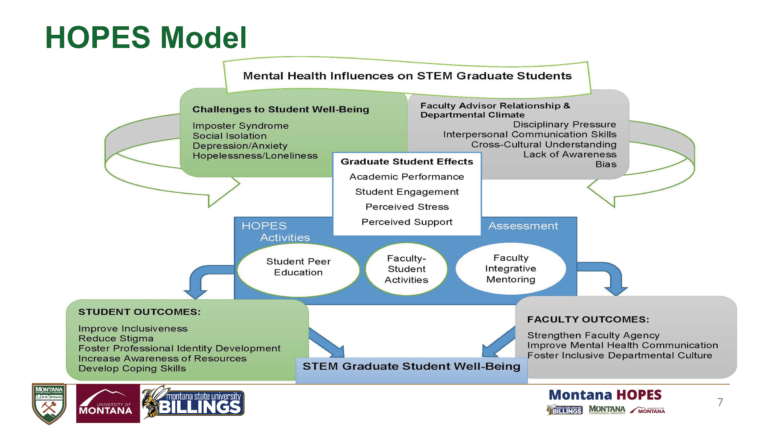
The Mental Health Opportunities for Professional Empowerment in STEM (HOPES) project began in August 2021 as a collaboration between Montana Tech, MSU-Billings, and the University of Montana, with funding support from the National Science Foundation. The project, which just completed its pilot year, is funded through Summer 2024. The goal of HOPES is to design, pilot, assess, and implement evidence-based,…
EPSCoR/IDeA Foundation Newsletter
The EPSCoR/IDeA Foundation has released an end of year (December 2016) Newsletter. The EPSCoR/IDeA Foundation (EIF) is a national, non–profit organization aimed at promoting the importance of a vibrant science and technology enterprise, primarily though improving the university research infrastructure and competitiveness of states that historically have received smaller amounts of federal research funding.
Four MSU Undergraduates Chosen for Applied Internship Program
In the new internship program offered through the Thermal Biology Institute (TBI), students work on campus directly with MSU faculty members, then complete an internship with industry research partners. The four students selected, and the locations of their summer internships, are Conner Bailey (Pacific Northwest National Labs), Evangaline Koonce (National Renewable Energy Lab), Daniel McDonald (Lucigen Corporation),…