Student opportunity (travel grants) for SEA Conference

The Computational and Information Systems Laboratory is offering travel grants to students who are interested in attending the sixth annual National Center for Atmospheric Research Software Engineering Assembly Conference (SEA). The conference will be held at NCAR’s Center Green Campus in Boulder, Colorado from April 10-14. This year’s theme is “the future of software engineering in academic and research-based organizations”. The conference will feature three days of tutorials, and host discussions on topics such as data analysis and visualization, security and compliance, Agile software development, and emerging technology trends. The travel grant will include airfare, lodging, and meals for the entirety of the conference. Those interested in attending the conference can apply for a grant at the travel grant application webpage . Deadline for application is February 24, 2017.

The Climate and Global Dynamics Laboratory (CGD) at NCAR is offering travel scholarships for students interested in attending their CESM Tutorial. CESM is a fully-coupled, community, global climate model that provides state-of-the-art computer simulations of the Earth’s past, present, and future climate states. The tutorial is August 14-18.

Similar Posts

  • Montana Innovation Day

    Montana Innovators joined Governor Schweitzer and MSU President Waded Cruzado on August 28th for a high-level panel discussion about investing in and fostering Montana’s innovation-driven economy, followed by an awards dinner celebrating select Montana companies for excellence in innovation. Panelists included Dan Berglund, President and CEO of the State Science and Technology Institute, a non-profit…

  • EPSCoR/IDeA Foundation Newsletter

    The EPSCoR/IDeA Foundation has released an end of year (December 2016) Newsletter.  The EPSCoR/IDeA Foundation (EIF) is a national, non–profit organization aimed at promoting the importance of a vibrant science and technology enterprise, primarily though improving the university research infrastructure and competitiveness of states that historically have received smaller amounts of federal research funding.

  • 2023 NSF EPSCoR Track-1 Solicitation

    NSF has released the solicitation for the 2023 RII Track-1. RII Track-1 awards provide up to $20 million total over five years to support research-driven improvements to jurisdictions’ physical and cyber infrastructure and human capital development in topical areas selected by the jurisdiction’s EPSCoR steering committee as having the best potential to improve future R&D competitiveness. 

  • UM awarded Track-2 in partnership with University of Nebraska

    UM Professor of Wildlife Biology, Zac Cheviron, is the PI on a newly awarded $4M RII Track-2 FEC project in partnership with the University of Nebraska Lincoln. The Using Natural Variation to Educate, Innovate, and Lead (UNVEIL): A Collaborative Research Network to Advance Genome-to-Phenome Connections in the Wild project targets understanding how organisms function in complex environments and how they…

  • Montana HOPES Project

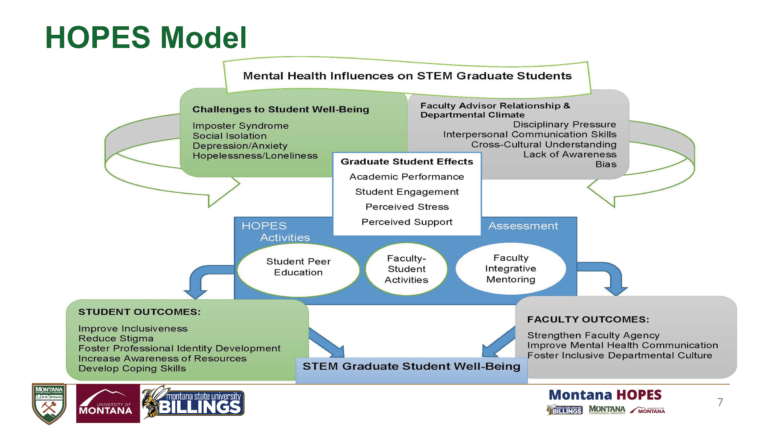
    The Mental Health Opportunities for Professional Empowerment in STEM (HOPES) project began in August 2021 as a collaboration between Montana Tech, MSU-Billings, and the University of Montana, with funding support from the National Science Foundation. The project, which just completed its pilot year, is funded through Summer 2024. The goal of HOPES is to design, pilot, assess, and implement evidence-based,…

  • Montana Track-2 Awards 2016

    On August 22, 2016 NSF EPSCoR announced Track-2 awards. Designed to build multi-jurisdictional collaborations, these awards cover two priorities: Research into fundamental questions about the brain and Research at the nexus of food, energy and water. Montana was awarded to work on 2 Track-2 projects. The first is a $6M research project led by Montana State University’s Benjamin Poulter (PI)…