
2016 Summer
June 23, 2016
Table of Contents
CLIMATE CHANGE AND ECOSYSTEM RESEARCH
Montana Team Studies Climate Change in Iceland
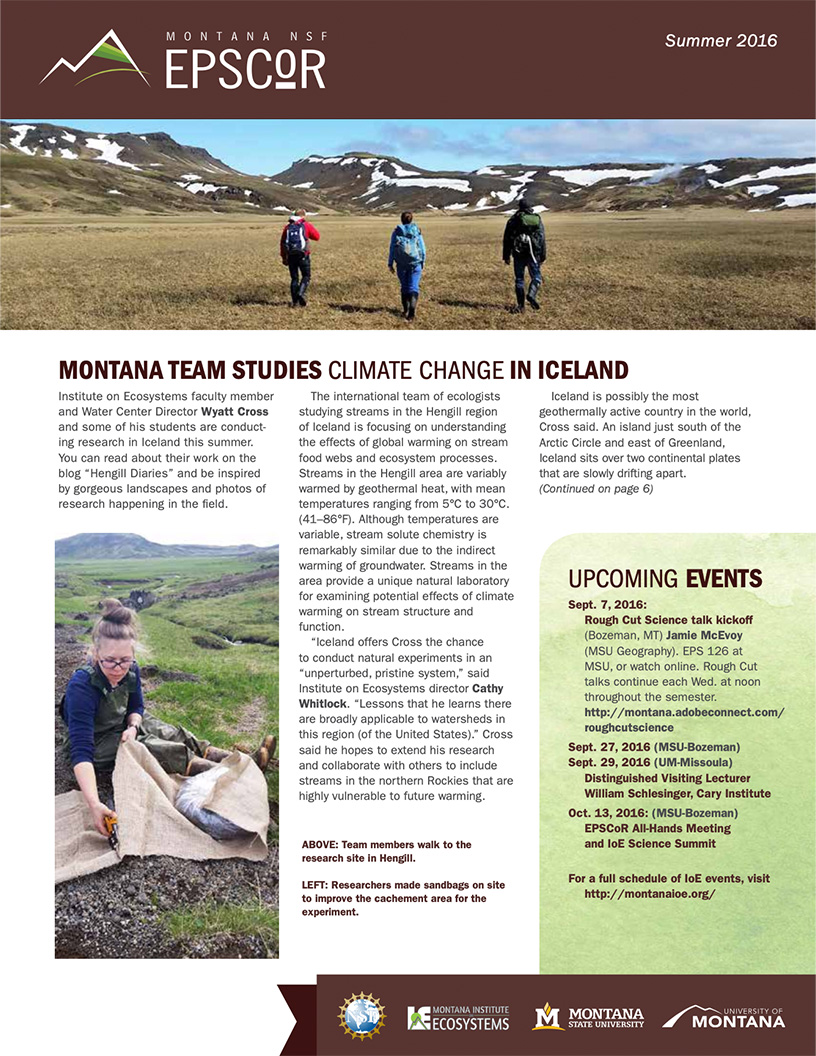
Researchers from Montana State University conduct field experiments in Iceland’s geothermally warmed streams to understand how rising temperatures affect aquatic ecosystems, food webs, and ecosystem services.
Key topics include:
- Climate change impacts
- Stream ecology
- Freshwater ecosystems
- Global warming research
- Iceland field studies
- Ecosystem services
- Water quality and nutrient cycling
Update: The Montana Climate Assessment
Researchers provide progress on Montana’s first statewide climate assessment, a stakeholder-driven effort examining how climate change may affect agriculture, forestry, water resources, communities, and ecosystems.
Focus areas include:
- Climate adaptation
- Montana agriculture
- Water resources
- Forest management
- Stakeholder engagement
- Climate science communication
Researchers Identify Gravel-Bed Floodplains as Critical Habitat Corridors
Scientists working across the Yellowstone-to-Yukon region identify gravel-bed river floodplains as ecological hotspots supporting birds, mammals, fisheries, and biodiversity throughout mountain landscapes.
Research themes:
- River ecology
- Floodplain conservation
- Wildlife habitat
- Yellowstone-to-Yukon ecosystems
- Landscape connectivity
- Biodiversity protection
STUDENT RESEARCH AND FELLOWSHIPS
NSF Graduate Research Fellowship Supports Wildfire and Vegetation Modeling
MSU doctoral student Kristen Emmett uses ecosystem models to examine how climate change may alter forest growth, wildfire frequency, and fire severity in the Greater Yellowstone Ecosystem.
Topics include:
- Wildfire science
- Forest ecology
- Climate modeling
- Yellowstone ecosystems
- Land management planning
Institute on Ecosystems Graduate Enhancement Awards Support 34 Research Projects
Graduate students across Montana universities receive support for research involving:
- Watershed restoration
- Whitebark pine conservation
- Wolf ecology
- Trout genetics
- Soil science
- Bat health
- Indigenous landscape studies
- Carbon and nitrogen cycling
- Pollinator research
- Invasive species management
Undergraduate Interns Conduct Research Across Montana and Beyond
Student researchers investigate:
- Yellowstone hot-spring microbiology
- Climate impacts on agriculture
- Carbon and nutrient cycling
- Wildfire history
- Water use by forests
- Pollinator health
- River ecology
- Whitebark pine genetics
- Glacier National Park microbiology
- Alpine ecosystem dynamics
PEOPLE AND RECOGNITION
University of Montana Climate Studies Director Receives National Clean Energy Award
Nicky Phear is honored by the U.S. Clean Energy Education & Empowerment initiative for leadership in climate education and clean-energy outreach.
Institute Researchers Featured in National Geographic and The Economist
Research on Yellowstone development, wildfire ecology, and mountain pine beetles receives national media attention.
INTERNATIONAL RESEARCH
Fulbright Fellow Studies Climate Adaptation in Slovenia
University of Montana geographer Sarah Halvorson examines how mountain communities perceive climate risks and respond to environmental change.
Research areas include:
- Climate adaptation
- Community resilience
- Mountain environments
- International environmental studies
- Climate vulnerability
EDUCATION AND PUBLIC ENGAGEMENT
Researchers Bring Ecosystem Science to Montana Classrooms
Institute scientists engage hundreds of Montana students through hands-on environmental science experiences and ecosystem education programs.
Montana Participates in National NanoDays Science Outreach
Faculty, students, and community partners connect the public with research in microbiology, water quality, and environmental science.
MSU Professor Publishes New Research on Edible Insects and Sustainable Food Systems
Florence Dunkel contributes major publications exploring insects as sustainable protein sources and future food systems.
OUTREACH AND COMMUNITY PROGRAMS
Yellowstone: Color It Wild Launches Ecosystem Education Through Art
A collaboration between Yellowstone National Park and the Institute on Ecosystems produces a regional coloring book featuring artists, writers, ecological interpretation, and public engagement opportunities.
Highlights include:
- Yellowstone National Park
- Environmental education
- Science communication
- Public outreach
- Arts and conservation
- Visitor engagement