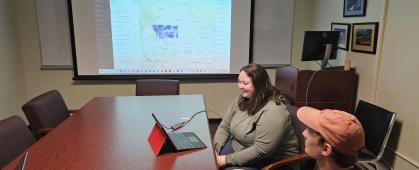
SMART FireS Smoke Vulnerability GIS Mapping Project
Kristen Intemann, Professor of Philosophy and Director for the Center for Science, Technology, Ethics, and Society (C-STES) at Montana State University (MSU), is working with graduate students in Land Resources and Environmental Sciences (LRES) at MSU to construct maps to analyze which communities and Tribal Nations are particularly impacted by both wildfire smoke and smoke from prescribed burns in Montana and across the U.S.
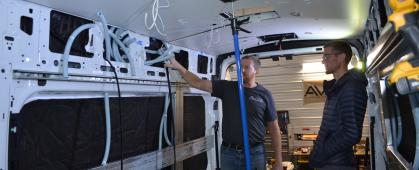
SMART FIRES researchers at UM build mobile smoke laboratory
SMART FIRES researchers at the University of Montana have begun to build the "Supervan," a rapidly deployable mobile laboratory with enough space and power for scientific instruments that measure, track, and sample prescribed fire and wildfire smoke.

Dr. Rob Walker to give Distinguished Professor Lecture on optical spectroscopy
Dr. Rob Walker, a professor in Montana State University’s Department of Chemistry and Biochemistry since 2009, has been appointed Distinguished Professor for 2024 in the university’s College of Letters and Science. It is the highest honor the college bestows upon a member of its faculty in recognition of contributions to the college, MSU and the scholarly community.

Women in STEM Feature: Libby Metcalf
Learn more about Libby Metcalf, her work on EPSCOR projects, and what inspired her to pursue a career in science!
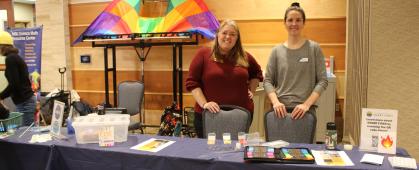
SMRC staff facilitate SMART FIRES activities at MSU Family Science Day
Staff from the Science Math Resource Center facilitated SMART FIRES activities for over 200 fifth grade students as part of MSU Family Science Day.
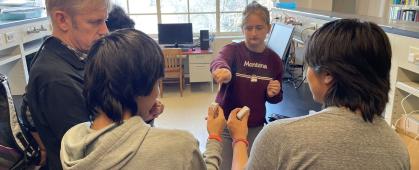
SpectrUM Day of Smoke and Fire Science
Students from Polson and Ronan High Schools on the Flathead Reservation visited the University of Montana on January 29, 2024, for a day of smoke and fire science with SMART FIRES. During a morning field trip to spectrUM Discovery Area, UM’s hands-on science center, the students explored the concept of the fire triangle and experienced a matchstick “forest” simulation, activities from the USFS’s FireWorks curriculum.
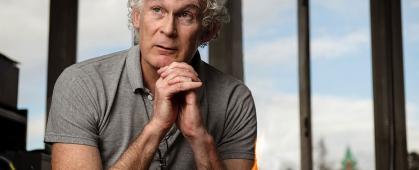
UM smoke researcher honored by major science organization
Bob Yokelson, an accomplished University of Montana researcher who studies biomass burning, recently was named a Fellow of the American Geophysical Union. AGU is the world’s largest Earth and space sciences association, with nearly 60,000 members in 137 countries.

Sensors Across the Curriculum: Modules Developed for K-12 Classrooms
At Montana State University, the Science and Math Resource Center (SMRC) and the EDU 370 class (Integrating Technology into Education) partnered to build the capacity of 45 undergraduate, pre-service teachers in their thinking about integrating sensors into diverse classrooms. SMRC supplied the class with microcontrollers (Circuit Playground Express) and any additional accessories for each member of the EDU 370 class.
Montana STEM Summit 2023 findings and next steps will be presented online Dec. 12
Key findings from the 2023 Montana STEM Summit will be shared in an online presentation on Tuesday, Dec.
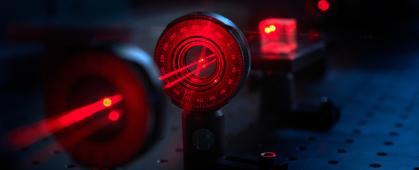
Montana State part of new regional tech hub focused on critical technologies for U.S. national security
Montana State University will be part of a new, federally designated regional technology hub focused on photonics and smart sensor technology, research areas in which MSU has decades of experience.
Upcoming Events
spectrUM Discovery Area
All Under One Roof (AUOR) Air Wildfire and Smoke Event
spectrUM and partners will have wildfire and climate-related activities and content from 3-5pm on April 25 for the public to learn and enjoy.
Virtual
Wildfires and Air Quality - Providing a Relevant Portal to Get Audiences Invested in the Conversation
During this online workshop hear from partners engaging audiences of all ages in Earth and climate science through activities that take a closer look at the scientific and societal impacts of wildfires.
Online
Free Citizen Science Webinar April 30 features Montana NSF EPSCoR
Citizen science is science for everyone! Specifically, citizen science is when the public voluntarily helps conduct scientific research. From sharing photos of nature to help scientists document biodiversity to browsing images on your computer to help speed up research about Alzheimer's disease, each of these acts of science is important.
spectrUM Discovery Area
All Under One Roof (AUOR) Air Wildfire and Smoke Event
spectrUM and partners will have wildfire and climate-related activities and content from 3-5pm on April 25 for the public to learn and enjoy.
Virtual
Wildfires and Air Quality - Providing a Relevant Portal to Get Audiences Invested in the Conversation
During this online workshop hear from partners engaging audiences of all ages in Earth and climate science through activities that take a closer look at the scientific and societal impacts of wildfires.
spectrUM Discovery Area
Brushstrokes of Change First Friday Art Show
spectrUM will host a public “gallery opening” style show on May 3 from 5-7 pm which will feature the climate art installation created by Big Sky High School 10th graders.